When setting up or running a lab, choosing the right materials is just as important as choosing the right equipment. Glassware is often seen as a standard, but not all glass is the same. Different types of glass are designed for different tasks, and understanding these differences can help you avoid breakages, improve results and make better purchasing decisions.
Below is a breakdown of the most common types of laboratory glass and where they are typically used.
Borosilicate Glass
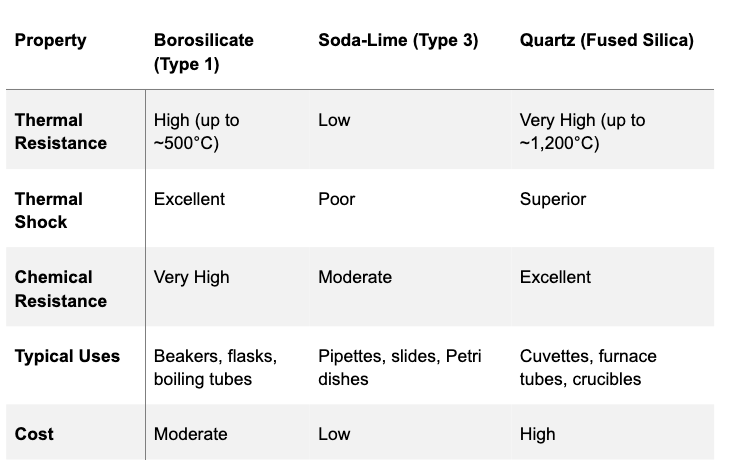
One of its key benefits is its low thermal expansion, meaning it does not expand or contract as much as standard glass when exposed to temperature changes. In practical terms, this makes it far less likely to crack when moving between hot and cold conditions. It is also clear, durable and resistant to many chemicals, which is why it is often used as a general-purpose option across laboratories.
Because of these properties, borosilicate glass is often the default choice for routine work, particularly where heating, mixing or transferring liquids is involved. It offers a good balance between performance and practicality, especially when you need one material to cover multiple applications. You may also come across different expansion ratings, with 3.3 being the most common standard, indicating a low expansion level and good resistance to temperature changes.
While borosilicate performs well in most situations, it is not completely inert. It should not be used with hydrofluoric acid, strong caustic (alkaline) solutions or phosphoric acid under certain conditions.
Soda-Lime Glass
Soda-lime glass is another common type of glass used in laboratories, typically found in more basic or single-use items rather than equipment designed for repeated heating. It is made from silica (sand), sodium oxide and calcium oxide, making it more cost-effective to produce than borosilicate glass.
It has a higher thermal expansion, meaning it is more likely to crack when exposed to rapid temperature changes. For this reason, it is generally not suitable for direct heating.
Instead, it is used for room temperature applications such as handling or transferring liquids. You will often find it in disposable test tubes, pipettes and some measuring cylinders, where cost and convenience are more important than long-term durability.
Soda-lime glass is also less chemically resistant, so it is best suited to simpler, lower-demand tasks or short-term use.
Silica Glass/ Quartz Glass (Fused Silica)
Silica glass, also known as quartz glass or fused silica, is used in more specialised laboratory applications where standard glass cannot perform. It is made from pure silica melted at very high temperatures (around 2,000°C), resulting in an extremely stable and high-purity material.
Its main advantage is its exceptional thermal resistance, allowing it to withstand temperatures far beyond borosilicate glass. It also offers excellent UV transparency, making it suitable for applications where light transmission is critical.
Because of these properties, it is typically used in high-temperature processes, UV work and high-purity environments. However, this performance comes at a significantly higher cost, so it is generally reserved for specific applications rather than everyday use.
Amber (Actinic) Glass
Amber glass, sometimes referred to as actinic glass, is designed to protect light-sensitive substances by blocking ultraviolet (UV) and some infrared (IR) light. Its dark brown colour helps prevent contents from degrading when exposed to light.
It is commonly used for storing materials such as vitamins, chemicals and other light-sensitive samples, usually in bottles or containers rather than heating equipment.
“Amber” refers to the colour and function rather than the base material, meaning it can be applied to different types of glass. It is also important to consider the cap and liner, as some liners may contain plastics that are not fully inert and could interact with the contents.
Plastic Coated Glassware
Plastic coated glassware is standard glassware, typically borosilicate, with an added external plastic coating to improve safety during use.
The coating helps contain fragments if the glass breaks, reducing the risk of injury and contamination. It can also improve grip, which is useful when handling liquids or working in busy environments.
This type of glassware is often used where safety is a priority, such as when handling hazardous substances or valuable samples. However, the coating does not make the glass unbreakable and may have limitations with high temperatures or certain chemicals, depending on the plastic used.
Summary
- Not all glassware is created equal, and choosing the right type depends on what you are trying to achieve.
- Borosilicate glass is the go-to for most general lab work
- Soda-lime glass is better suited to low-cost, low-demand or disposable use
- Quartz glass is reserved for high-performance, specialist applications
- Amber glass is essential for protecting light-sensitive materials
- Plastic coated glassware adds an extra layer of safety where needed
Understanding these differences helps ensure you are using the right material for the job, improving reliability, reducing waste and avoiding unnecessary costs.