
Petri dishes are one of the most recognisable and widely used tools in the laboratory, yet choosing the right type is not always straightforward. With options ranging from plastic and glass materials to vented, non-vented and sectioned designs, each variation is suited to different applications and working environments.
Understanding these differences helps you choose the right Petri dish for your application, ensuring more reliable results whilst avoiding unnecessary costs.
What is a Petri dish?
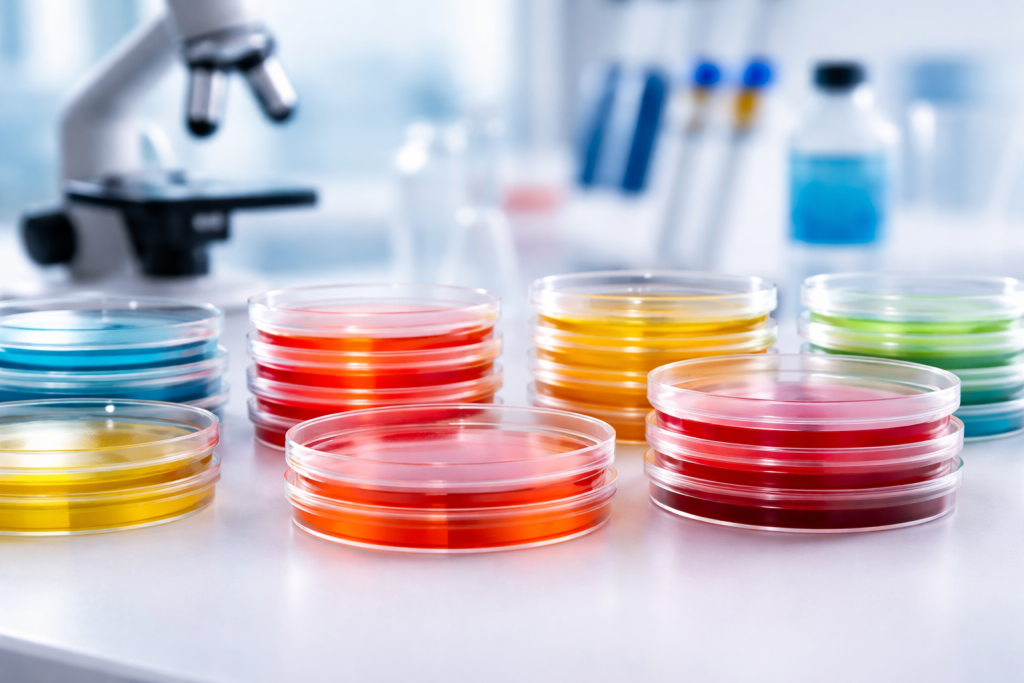
A Petri dish, sometimes called a culture dish, is a shallow, clear dish with a lid designed for growing, observing and handling samples under controlled conditions. It provides a stable surface for culture media and is widely used in biological and microbiological work, particularly for growing microorganisms.
Petri dishes are widely used for cultivating microorganisms, antibiotic testing, studying cell growth and detecting contamination in samples. They can also be a simple and engaging way to explore science at home, such as observing seed germination with children. More recently, Petri dishes have become increasingly familiar to the wider public through social media, where they are often used to show how much microbial growth can be found on everyday surfaces and objects, helping to highlight hygiene and contamination in a more visual way.
Petri dishes are available in a range of sizes, typically from 35 mm to 150 mm, making them suitable for everything from small-scale sample work to routine culturing and testing applications.
The Different Types of Petri Dish
Sectioned Petri Dishes
When buying a Petri dish, you may notice that some options come with different numbers of compartments. These are known as sectioned Petri dishes and are designed to hold multiple samples or culture media within a single plate. Typically available in 2, 3 and 4 section formats, they are useful for comparative testing, routine observations and applications where saving space and reducing the number of dishes used can be beneficial. By allowing several tests to be carried out side by side, sectioned Petri dishes can help make workflows more organised, efficient and cost-effective.
Plastic vs Glass Petri Dishes
When choosing a Petri dish, one of the main differences you will see is whether it is made from plastic or glass. Each option has its own advantages depending on the application, handling needs and testing environment.
Plastic Petri dishes are typically used for single-use applications where reducing cross-contamination is important. They are lightweight, less likely to break during handling and often available pre-sterilised, which can help improve workflow efficiency in high-volume labs. This makes them a practical choice for clinical testing, food safety work, biotech and pharmaceutical settings, as well as schools and educational use. They are often more cost-effective for large projects, although single-use plastic can create more waste over time.
Glass Petri dishes are usually made from borosilicate glass or soda-lime glass, are well suited to repeated use, as well as applications involving staining or regular chemical exposure. Borosilicate glass is often preferred where heat resistance is important. Its high optical clarity also makes it easier to observe fine details under a microscope without disturbing the sample inside. They are commonly used in academic research, environmental monitoring, QA and QC work, and other settings where durability and reusability are more important than disposable convenience. Although heavier and more breakable than plastic, glass dishes can be a more practical long-term option for some laboratories.

Vented vs Non-Vented Petri Dishes
Vented Petri dishes include small, raised features on the inside of the lid, preventing it from sitting completely flush with the base. This creates a slight gap that allows for gaseous exchange, which is important for supporting microbial respiration during incubation.
Single-vented Petri dishes
Single-vented dishes have a small opening at one point around the lid, allowing for limited airflow. This helps support growth whilst reducing evaporation and maintaining moisture within the media.
They are commonly used for:
– Routine agar plating, such as streaking bacterial cultures
– Short incubation studies, where media dehydration needs to be controlled
– Colony isolation work, where consistent surface conditions are important
– Educational practicals, where ease of use and reliability are key
Triple-vented Petri dishes
Triple-vented dishes feature multiple raised points around the lid, allowing for increased airflow and more consistent gaseous exchange. This helps reduce condensation, which can otherwise interfere with colony formation and visibility.
They are typically used for:
– Aerobic bacterial culture, where oxygen availability directly impacts growth
– Environmental surface testing, such as contact plates or swab plating
– Air monitoring and settle plate studies, where exposure to air is required
– Longer incubation periods, where condensation build-up would affect results
The increased airflow improves growth conditions but does introduce a slightly higher risk of contamination.
Non-vented Petri dishes
Non-vented petri dishes have no raised features, meaning the lid sits fully on the base to create a more closed and controlled environment. This helps minimise contamination and maintain stable internal conditions.
They are best suited to:
– Sterility testing, where external contamination must be minimised
– Sample transport and storage, keeping plates sealed before or after incubation
– Anaerobic culture setups, where oxygen exposure needs to be limited
– Precise analytical work, where reproducibility and controlled conditions are critical
Whilst offering better protection, non-vented dishes can lead to increased condensation, particularly during incubation.
Top tip! Petri dishes are often incubated upside down to help reduce condensation dripping onto the culture surface. This also helps slow moisture loss from the media, creating more suitable conditions for microbial growth.
Sterile vs Aseptic vs Non-Sterile Petri Dishes
Sterile
Sterile Petri dishes have been treated to remove all viable microorganisms, typically through methods such as gamma irradiation or ethylene oxide sterilisation. This means they are free from contamination at the point of use, making them suitable for applications such as culturing microorganisms, sterility testing or any work where reliable, uncontaminated results are essential.
Aseptic
Aseptic Petri dishes are manufactured and packaged under controlled clean conditions to minimise contamination during production, but they are not guaranteed to be completely sterile. They are typically used where a reduced level of contamination is acceptable or where further sterilisation steps will be carried out before use.
Non-Sterile
Non-sterile Petri dishes are supplied without any sterilisation or controlled aseptic handling. They are generally used for tasks where sterility is not required, such as media preparation, storage or general handling. If they are to be used in microbiological applications, they would need to be sterilised before use to ensure accurate and contamination-free results.

Summary
Petri dishes may appear simple, but the differences between materials, venting options and sterility levels can have a significant impact on performance and suitability for different applications. From plastic or glass construction to vented or non-vented designs, each variation offers its own balance of airflow, contamination control and practicality.
By understanding these differences, laboratories can select the most appropriate option for their specific workflow, whether that involves routine culturing, controlled testing or general laboratory use. Choosing the right Petri dish not only improves efficiency but also helps ensure more reliable and consistent results.
Explore our range of Petri dishes.Sold here
You can use Parafilm to seal your Petri Dish. Sold here